Creative tools & workflows
Perplexity vs ChatGPT: Research You Can Verify
Compare documented research workflows, citations, files, and plans. Learn the four-step source audit that turns a clickable citation into a verified claim.
· · Diagram Studio Editorial
When a competitor-pricing audit has to stand up to questions, the assistant you choose changes how the work gets done. It controls how you discover sources, how citations attach to claims, and what survives into the final deliverable. Perplexity and ChatGPT both document capable web-research workflows, so the simple view of one as a search engine and the other as a chatbot undersells both.
A citation count proves nothing by itself, and citations do not guarantee that a source supports the claim they sit beside. The practical question is which workflow fits the shape of your task, and how you will verify the sources before relying on the output. This comparison uses the products’ official documentation, help pages, pricing pages, and changelogs, checked on 4 November 2026. It is not a side-by-side benchmark, and it makes no speed, accuracy, or citation-quality claim.
Direct answer
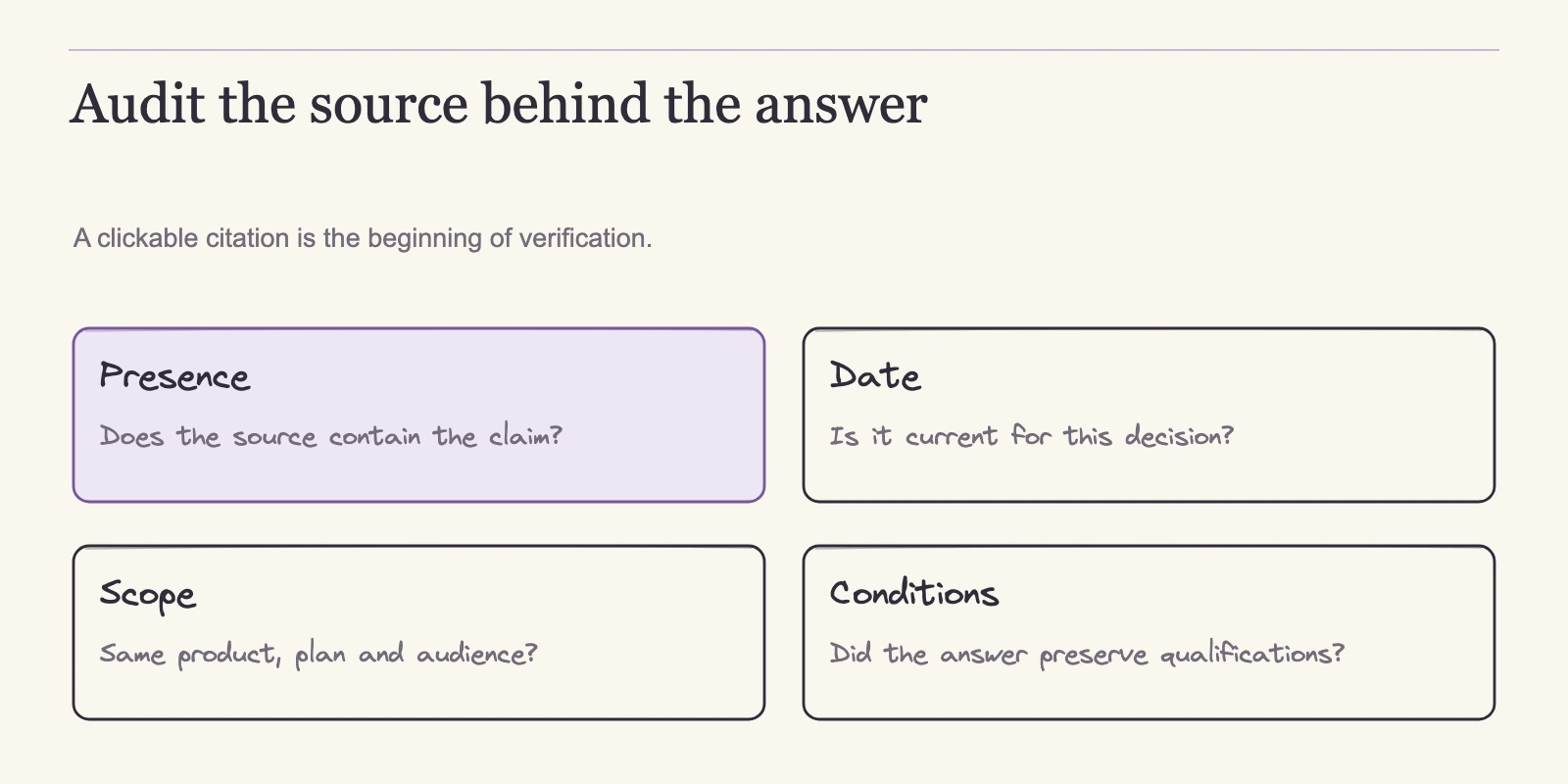
Neither tool wins outright; the comparison examines documented workflows, not hands-on results. Choose by task shape: dated lookups, multi-source investigations, iterative projects, file work, or finished deliverables. Verify each source yourself: does it contain the claim, is it current, does it match the plan’s scope, and are its conditions preserved? A clickable citation proves nothing until those checks pass.
What the documentation can and cannot settle
Official documentation tells you what a product is designed to do and where its creators point you for evidence. It is not a guarantee that a task will succeed, that a given plan includes the feature, or that any cited page contains the claim. Two rules keep this comparison useful. First, report a price or capability only at the scope where the source states it. Second, if a behavior appears in one vendor’s documents but not another’s, that is a gap in the record, not proof the product lacks it.
Both products have moved well past a simple search-versus-chatbot divide. Perplexity documents automated search, model selection, file analysis, and generated deliverables. ChatGPT documents first-party search, a Work surface for research and files, and deep research with a reviewable report. Once both sides claim research and creation workflows, the comparison becomes a question of how you inspect what each one returns.
Two research workflows, built differently
Perplexity: automatic search and an expanding creation layer
Perplexity’s Pro Search applies automatically to eligible search tasks until the plan limit (Perplexity Pro help). That removes a setup step, but it also means you do not control when Pro Search runs. The product decides, and the visible citation trail is where you see what happened.
Research mode works differently. Instead of asking you to pick a model, it selects a combination of models for the task. On Pro and Max plans you can prefer a specific model, but Research mode deliberately removes that manual choice. The tradeoff is transparent: you trade direct model control for a workflow the vendor assembles.
The creation layer extends beyond answers. Perplexity’s Create files and apps workflows can generate reports, spreadsheets, dashboards, and simple web applications, and file analysis accepts PDF, CSV, and other media uploads. Presentations are also part of the documented set. The March 2026 changelog describes presentations and other structured outputs produced by Pro Search and Deep Research (Perplexity’s March 2026 changelog), and the subscription plan page separately names presentations under Max’s Create allowance (Perplexity plan help).
Projects are documented too. A Perplexity changelog describes shared Computer workspaces designed for long-running tasks, with persistent files, project-scoped connectors, and context across work, and notes that existing Spaces migrate to these Projects (Perplexity’s shared-workspaces changelog). Account-level memory features remain conditional, so access can depend on your account type and enablement. The important point for a research decision is that long-running thread continuity is not a ChatGPT-only feature.
ChatGPT: search, Work, and deep research on separate surfaces
ChatGPT’s documentation treats research as a set of distinct surfaces. Web search is a first-party feature: on the web, search results and citations appear when search is used, and workspace settings can restrict availability (ChatGPT web-search documentation). The guidance is to ask for current information or sources when you need them. That is a practical instruction, not a claim that search is always a manual action or always automatic.
Deep research lives in Work rather than in ordinary Chat. It is documented as an investigation across multiple sources that returns a reviewable report, with availability depending on the account or workspace. Work itself is the broader surface for research, analysis, files, and connected tools, with documents, presentations, spreadsheets, and other outputs (ChatGPT web documentation). Projects keep related chats, files, and instructions together, which matters when a research thread spans several sessions.
The surface distinction is important. ChatGPT’s pricing documentation covers shared Work and Codex usage, not consumer Chat plans, and API pricing is separate. A capability described for Work should not be treated as a universal consumer Chat feature.
The documented research workflow at a glance
| Area | Perplexity documents | ChatGPT documents |
|---|---|---|
| Search | Pro Search applies automatically to eligible tasks until the plan limit | First-party web search; results and citations appear when search is used, and workspace settings can restrict availability |
| Multi-source work | Research mode selects a combination of models; a changelog describes Deep Research producing structured outputs | Deep research in Work investigates multiple sources and returns a reviewable report |
| Project continuity | Projects: persistent files, project-scoped connectors, and context across work | Projects in Work keep chats, files, and instructions together |
| File inputs | PDF/CSV and other media uploads can be analyzed | Files and connected tools are part of the Work surface |
| Deliverables | Reports, spreadsheets, dashboards, simple web applications, and presentations | Documents, presentations, spreadsheets, and other outputs |
Neither column is a quality score. Both columns describe what the vendor says the product is designed to do.
Match the workflow to the task shape
The documented differences matter most when they change what you can inspect. Task shape is the practical filter.
Dated pricing and factual lookups
For a quick lookup of a current price or policy, either product can work. Perplexity’s automatic Pro Search saves a step, while with ChatGPT you should ask for current information or sources. The verification burden is identical: open the cited page and confirm that it displays the figure, carries a relevant date, and refers to the exact plan tier and billing term you are checking.
Multi-source investigations
For a policy brief or competitive review that draws on many sources, both products document multi-source work. ChatGPT Work describes deep research as an investigation across multiple sources that returns a reviewable report. Perplexity’s Research mode selects a combination of models for the task, and its changelog describes Deep Research producing structured outputs. Because both document this workflow, the deciding factor is what your plan actually includes and how completely you can inspect the final output’s source list. In either case, confirm that the final answer preserves original dates and qualifications.
Long-running iterative analysis
When you revisit the same question across several sessions, project containers matter. ChatGPT Work documents Projects that keep chats, files, and instructions together. Perplexity’s changelog documents Projects with persistent files, project-scoped connectors, and context across work. Both records exist, so the choice comes down to which project model matches your team’s workflow and which plan includes it.
File-based research
Both tools document file inputs. Perplexity names PDF, CSV, and other media uploads with file analysis. ChatGPT Work names files and connected tools as part of its research surface. The pages do not enumerate every accepted format, so check current upload limits and file types in your own account before trusting either with a large dataset.
Finished deliverables
Choose the workflow by the format you need to produce. Both products document documents, presentations, and spreadsheets. Perplexity also documents dashboards and simple web applications. Matching the format is necessary, but it is not sufficient: a generated spreadsheet or deck still needs its numbers traced to sources you can open and read.
A citation is a pointer, not a promise
The hardest habit to break is treating a citation as proof. A citation directs you to a page. It does not confirm that the page contains the claim or that the answer preserved the source’s qualifications.
Three relationships make the difference practical.
| Relationship | What it looks like | What you can conclude |
|---|---|---|
| Direct citation | A link attached to the specific claim | A source was offered; open it and confirm the claim appears there |
| Nearby general link | A link placed near the claim but not tied to that exact sentence | The source may cover the broader topic; it is not evidence for this claim |
| Condition-preserving answer | The output keeps the source’s date, scope, and qualifications | You can check the claim against its original context without recovering dropped nuance |
Take the claim “Perplexity Pro costs $17/month.” A direct citation links to the pricing page, which displays Pro at $17 on the Individual card. A nearby general link might point to an article that discusses AI pricing broadly without ever stating $17; it is related, but it does not support the sentence. A condition-preserving answer adds the qualifier that makes the claim checkable: $17 is an annual-billing equivalent as shown on the pricing page, not a confirmed monthly checkout price (Perplexity pricing). All three look similar. Only one lets you verify without recovering assumptions later.
Perplexity’s pricing page lists inline citations and premium data sources, and presents inline citations as showing where each claim comes from. That is the vendor’s promise, not independent proof that each cited source supports the claim. ChatGPT’s documentation is more direct: it instructs users to treat web results as untrusted input (ChatGPT web-search documentation). That is the clearest documented statement in this comparison that verification is the reader’s job.
Citation counts measure presence, not support. A response can include several links and still be wrong if none of them contains the claim. A single careful citation that preserves the source’s date, scope, and qualifications is more useful than many decorative ones.
Audit a source with a worksheet
A practical source audit starts with a table you can fill in for every claim you intend to rely on.
| Claim | Cited URL | Publisher | Published or updated | Passage that supports the claim | Primary or secondary | Contradiction | Disposition |
|---|---|---|---|---|---|---|---|
| Example: Perplexity Pro costs $17/month | pricing URL | Perplexity | checked 4 November 2026 | “Pro $17/month billed annually” | Primary | None found | Accept with qualifier: annual-billing equivalent |
Copy that table into your research notes and fill one row per claim. This is a template for your own process, not a completed test.
Four checks drive the worksheet.
- Presence. Does the source actually contain the claim? If the page discusses the topic but never states the specific figure or fact, the citation does not support the sentence.
- Date. Is the source current enough for the question? Pricing pages decay quickly; policy documents may remain valid longer.
- Scope. Does the source cover the plan, tier, timeframe, or account type in question? An enterprise pricing page does not verify an individual plan.
- Conditions. Are the source’s qualifications preserved? If the source says a price is an annual-billing equivalent, that qualifier belongs in the answer.
Here is the worked audit for the claim “Perplexity Pro costs $17/month.”
- Presence: the pricing page displays Pro at $17 on the Individual card.
- Date: the page was checked and confirmed on 4 November 2026.
- Scope: the figure belongs to the Individual card, not the Enterprise section.
- Conditions: the card labels the price as an annual-billing equivalent. The claim is accurate only with that label attached. A monthly checkout price is not confirmed, so the answer should not imply one.
The same four checks apply to any output from either tool. The method is a filter, not a guarantee. It tells you whether a claim survives contact with its source, not whether the source is the final word on the subject.
Common failure modes are easy to recognize once you are looking for them. A cited-but-unsupported source is a link that never states the claim. A stale source is a page that predates the decision you are making. An inaccessible source is paywalled, login-gated, or broken, so you cannot verify it at all. Conflicting sources are normal; when they appear, check dates and scope first, prefer primary sources over summaries, and state the precise disagreement rather than letting an assistant smooth it over.
Prices, plans, and the billing unit trap
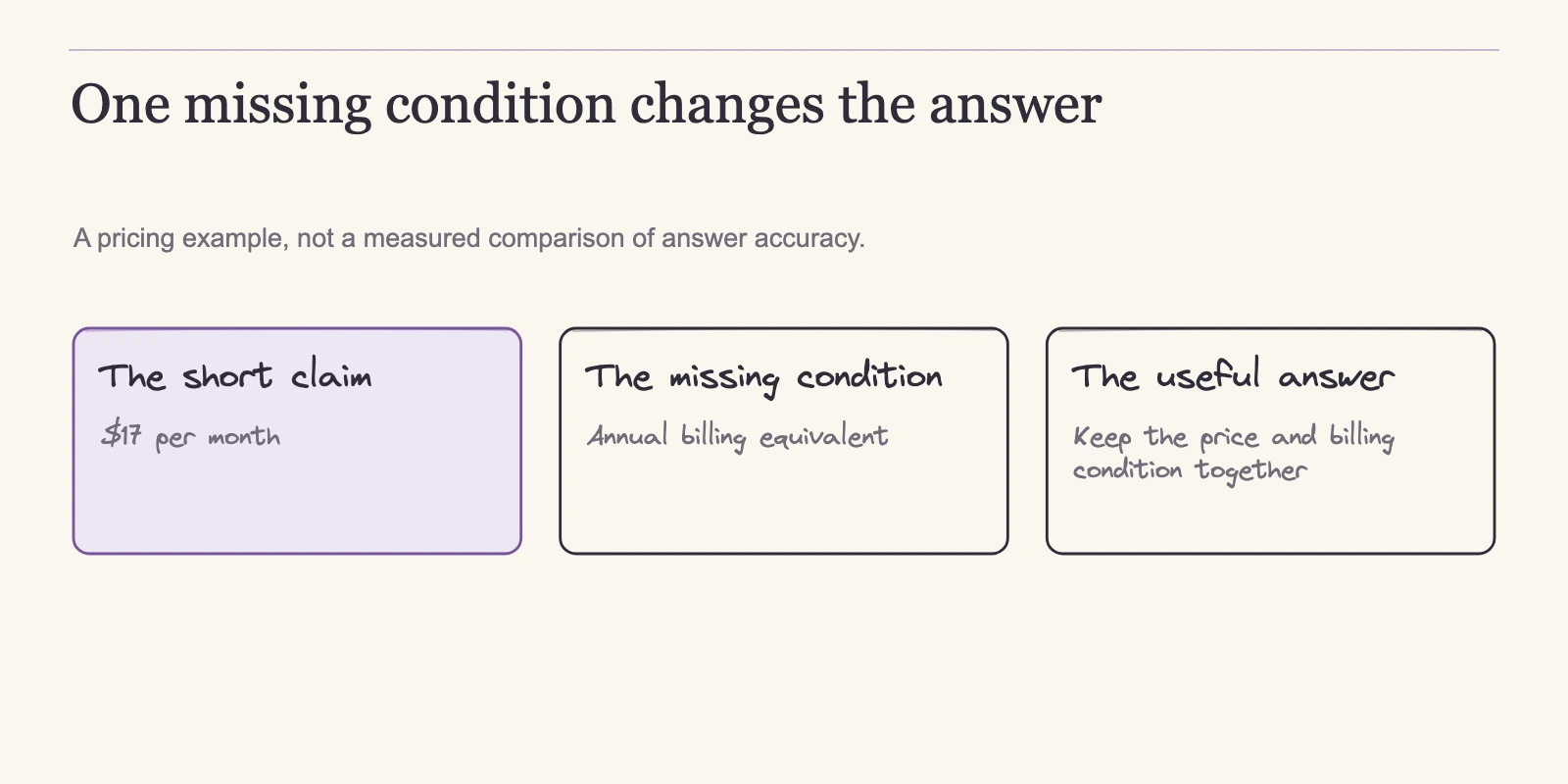
Price comparison fails when the units differ. The relevant numbers come from vendor pages checked on 4 November 2026, and plan pages change, so recheck the live page before buying.
Perplexity’s pricing page shows Individual cards at Free $0, Pro $17, and Max $167, with Pro and Max labeled as annual-billing equivalents (Perplexity pricing). The page has Individual and Enterprise toggles, so those are individual plan prices, not enterprise deals. Monthly checkout prices were not exposed on the page. Education Pro is described separately at $10/month and requires verification, so its wording does not transfer to ordinary Pro (Perplexity plan help).
ChatGPT’s pricing documentation covers shared Work and Codex usage: Free $0, Go $8, Plus $20, and Pro from $100 with $100, $200, and $500 options (ChatGPT Work and Codex pricing). The page is explicit that API pricing is separate and that this is not consumer Chat pricing. The Plus price is marked per month.
| Service | Tier | Documented price | Billing unit | Scope boundary |
|---|---|---|---|---|
| Perplexity | Pro | $17 | Annual-billing equivalent | Individual card |
| Perplexity | Max | $167 | Annual-billing equivalent | Individual card |
| Perplexity | Education Pro | $10 | Per month, requires verification | Education users |
| ChatGPT | Plus | $20 | Per month | Shared Work/Codex page |
| ChatGPT | Pro | From $100 | Per month, with $100/$200/$500 options | Shared Work/Codex page |
If Perplexity’s annual-billing equivalent holds for twelve months, Pro works out to $17 × 12 = $204 per year. That arithmetic assumes a twelve-month period; the exact checkout invoice could still differ. ChatGPT Plus is $20 per month, so a twelve-month sequence totals $20 × 12 = $240. Compare those numbers only after checking that each plan’s billing period matches the budget window you care about.
Paid tiers change access, not the need to verify. Perplexity’s Pro and Max tiers permit preferred-model selection, and the help center describes Pro as increasing search, model, and file access with a limited Create allowance; Max raises access further. ChatGPT’s tiers on the Work/Codex page differ in what they include on those surfaces. None of those changes removes the requirement to check whether a cited page contains the claim.
Take a research brief from start to checklist
A workflow becomes concrete when you apply it to a real deliverable. Consider a software-pricing change audit.
- Assignment: verify whether a named AI product changed its prices since 1 September 2026.
- Deliverable: a one-page memo listing each price before and after, the effective date, and the source.
- Scope: vendor official pricing pages and changelogs only; exclude third-party reviews for price facts.
- Date boundary: changes from 1 September 2026 to the day you work.
- Required citations: for each price change, the URL, publisher, published or updated date, exact plan tier, billing period, and effective date.
- Acceptance: every figure passes presence, date, scope, and conditions, and any conflicts are listed rather than hidden.
Run this through the full path: discovery, source verification, synthesis, revision, and the shareable deliverable. Use the tool to find the vendor pricing page and changelogs. Then open each cited page and fill in the worksheet. Write the memo with direct claims and inline links. Before you finalize, rerun the four checks on every claim, and if two sources disagree, state the disagreement. No tool can do that final step for you.
Frequently asked questions
Which is better for research?
Neither product can be declared better from documentation alone. Choose by task shape: quick sourced lookups work in either product, multi-source reports are a documented workflow in both products, and long-running projects now have documented containers on both sides. Then audit the sources before relying on the output.
Does an inline citation mean the claim is verified?
No. An inline citation is a pointer, not proof. Run the four checks: does the page contain the claim, is it current, does it cover the exact plan or timeframe, and are its conditions preserved? If any check fails, treat the claim as unverified.
How do I compare plans when prices are quoted differently?
Align billing units and page scope first. Perplexity Pro is $17/month billed annually on the Individual card. ChatGPT Plus is $20/month on the shared Work/Codex pricing page. Annualizing the two assumes a twelve-month period, and Perplexity’s monthly checkout price was not exposed, so keep the qualifier attached.
Is ChatGPT Deep research available in every account?
No. The documentation says availability depends on the account or workspace, and the pricing page covers shared Work and Codex usage, not consumer Chat. Check your own account before assuming deep research is available.
Does Perplexity support projects and presentations?
Yes. A changelog describes Projects with persistent files, project-scoped connectors, and context across work, and another changelog documents presentations from Pro Search and Deep Research. Check plan access and current availability, because account-level conditions vary.
Do I need a paid plan to verify sources?
No. Verification is a reader-side step at every tier. Paid tiers change search, model, and file access, not the requirement to check whether a cited source contains the claim and preserves its conditions.
Conclusion
The central question is not which assistant is smarter. It is which documented workflow fits your task and whether you are prepared to verify what it returns. Perplexity and ChatGPT both provide research surfaces, citations, file handling, and generated deliverables. The distinction that survives across every section is the one between a clickable citation and a verified claim.
Start with the task shape: a dated lookup, a multi-source investigation, iterative analysis, file-based work, or a finished deliverable. Match the workflow whose documented behavior fits that shape. Then run the source audit on the claims you intend to use. Presence, date, scope, and conditions turn a citation from a pointer into a checked claim.
A practical next step takes less than an hour. On your next research task, write down the three most important claims you need to rely on, open the sources attached to those claims, and fill in a worksheet row for each one. If all three pass, you have a defensible basis for the decision. If any fail, you know exactly where to look before you build on top of it.