AI design tools
What Claude Design Costs in Usage: The Published Limits, the Reported Burn, and How to Spend Less
Claude Design shares one usage pool with Claude chat and Claude Code, and Anthropic publishes no numbers. Here is what is documented, what users report, and what you can do to spend less.
· Diagram Studio Editorial
Direct answer
As of October 1, 2026, Anthropic's help page says Claude Design counts toward the same usage limits as the rest of Claude, including Claude Code, with no separate allowance. It is in beta on Pro, Max, Team and Enterprise plans. Anthropic publishes no per-prompt token figures; its only cost guidance is that large codebases and many iterations use more. Usage credits can extend work past the limit.
The short answer: one pool, no published price list
Claude Design does not have its own usage meter. Anthropic's help page states that it counts toward the same limits as the rest of Claude, drawing from the same pool as chat and Claude Code. A long design session and a long coding session spend the same budget.
Claude Design counts toward the same usage limits as the rest of Claude. Design activity draws from the same pool as the rest of your work with Claude, including Claude Code, so there's no separate Claude Design allowance to track.
Two facts follow from that and are worth separating from everything else you will read. First, the limits themselves are not published as numbers for Claude Design: there is no figure for tokens per prompt, prompts per week, or the cost of onboarding a design system. Second, the only cost guidance is directional. Anthropic says complex projects with large codebases or many iterations consume more usage, and that a larger request such as a full deck or design uses more of your limit than a typical message.
This article is built on Anthropic's own pages, fetched on October 1, 2026, plus named third-party reports that are labelled as reports. We have not used Claude Design ourselves, so nothing here is a measurement. Limits, plan availability and the product's beta status change often; treat everything below as true on that date and check the linked pages before you rely on it.
What is documented, reported, and unknown
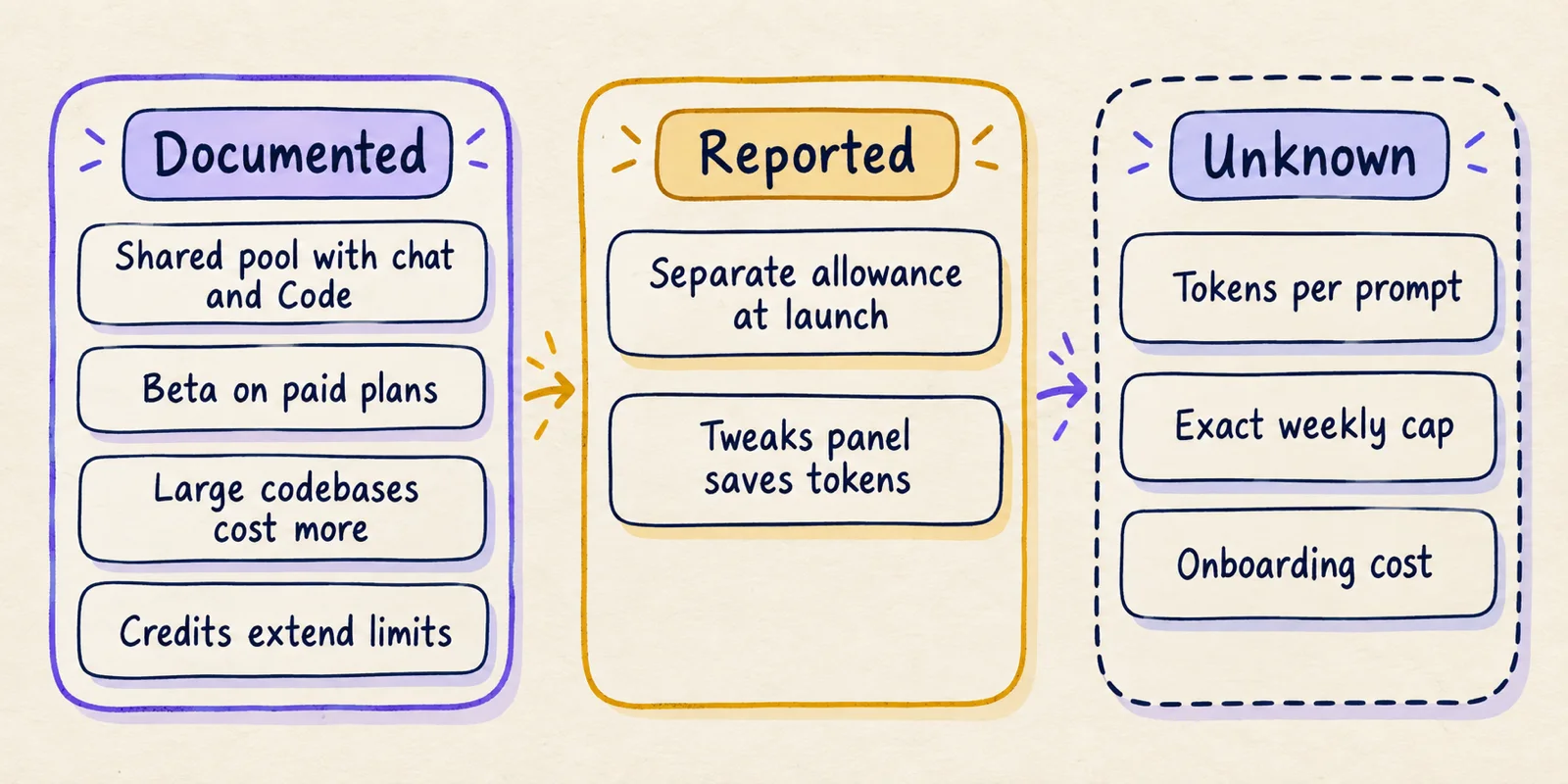
The table below sorts every claim in this article into one of three groups. Documented means it appears on an Anthropic page. Reported means a named person or publication said it. Unknown means no source we could find answers it.
| Claim | Status | Source |
|---|---|---|
| Counts toward the same limits as the rest of Claude, including Claude Code | Documented | Claude help page |
| In beta on Pro, Max, Team and Enterprise; on by default except Enterprise | Documented | Claude help page |
| Large codebases and many iterations consume more usage | Documented | Claude help page |
| Design is unavailable when you hit the limit, unless usage credits are enabled | Documented | Claude help page |
| Design previously had its own weekly allowance | Documented (past tense) | Claude help page |
| Token limits were doubled across every plan on May 18, 2026 | Documented (Anthropic post on X) | @claudeai |
| A user hit a separate Design limit within hours of launch | Reported | Josh Gonsalves on X |
| Building a design system uses a noticeable chunk of the week | Reported | Muzli, Eyal Zuri |
| The Tweaks panel does not spend chat tokens | Reported, pre-merge | Muzli, Eyal Zuri |
| Tokens or percent of limit per prompt, per onboarding, per export | Unknown | No Anthropic figure found |
| The exact weekly cap per plan for Design | Unknown | No Anthropic figure found |
| Whether the May doubling still applies after the pools merged | Unknown | Inference only; not stated |
How the limits changed since launch
Claude Design launched on April 17, 2026 as a research preview from Anthropic Labs, according to Anthropic's launch post. That post already said access uses your subscription limits. The help page today describes the product as being in beta, and says it previously had a weekly allowance separate from other usage.
That history matters because advice written in the first weeks describes a different system. On launch day a user posted that Design had its own limit and he had already hit it.
Oh, so Claude Design has it's own usage limit outside of everything else? And of course, already hit it... So now I can't use it until NEXT FRIDAY? OK...
— Josh Gonsalves (@joshgonsalves_) View on X
On May 18, 2026 Anthropic's Claude account announced the first change we can document.
You can now create more with Claude Design. We've doubled token limits across every plan.
— Claude (@claudeai) View on X
Around May 27 to 28, users reported an in-app notice reading that Claude Design now shares usage limits with Claude.ai and Claude Code. PiunikaWeb covered it on May 28 and said Anthropic had not yet issued a statement, so at that point the merge was reported rather than documented. The help page now documents it.
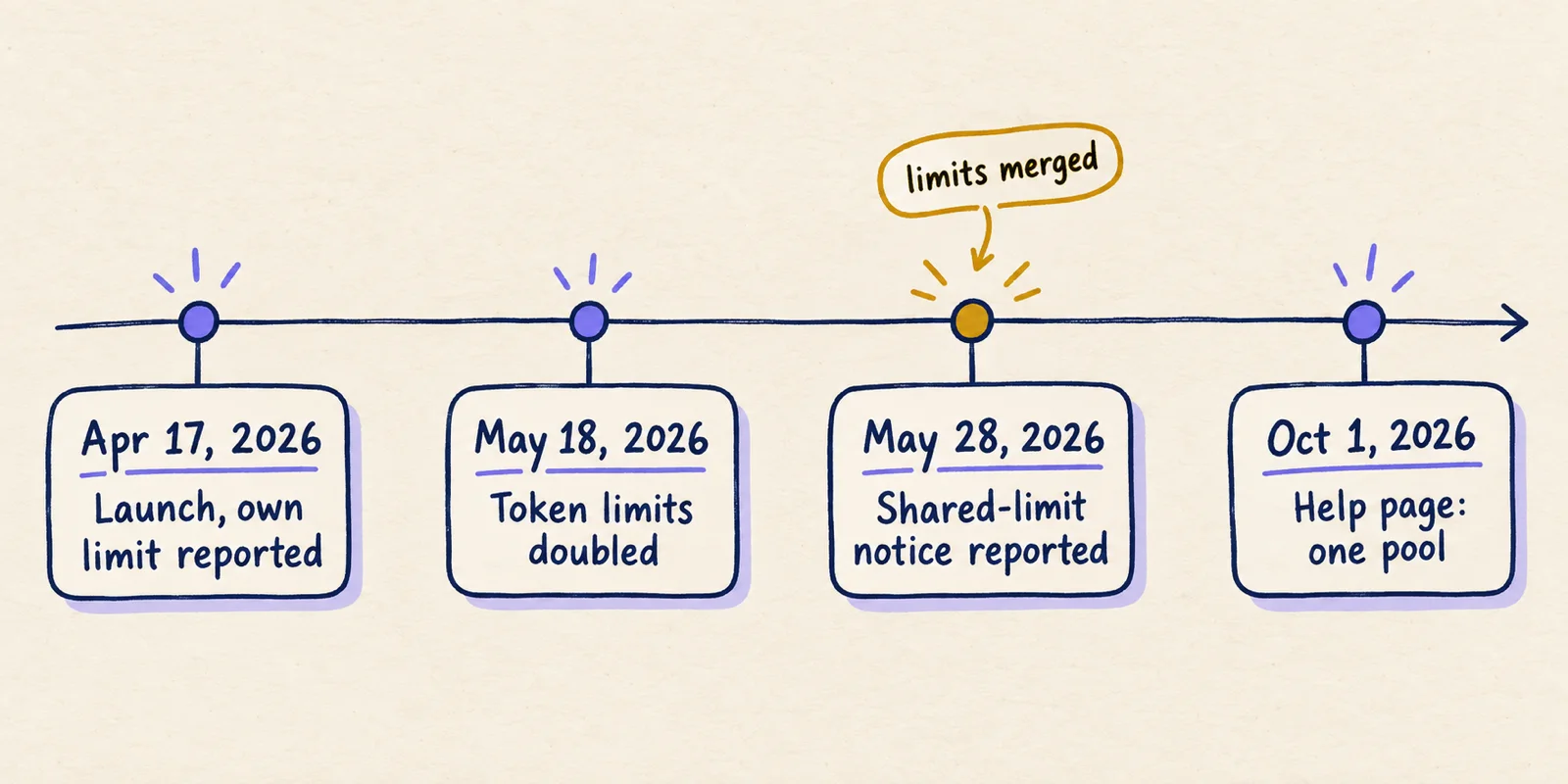
One thing we cannot determine: whether the May 18 doubling applied to the separate Design allowance only, or carries into the shared pool. Anthropic's post says token limits doubled; the later help page does not mention it. Treat any claim that Design “now has double the usage” as unverified.
How usage is counted compared with normal chat
Claude counts tokens, not messages. A token is a small chunk of text, roughly a word fragment, and both what you send and what Claude produces consume the budget. Anthropic's usage help page says usage depends on the length and complexity of conversations, the features you use, the model, and the effort level, and that tools and connectors are token-intensive.
Plans have a five-hour session limit and a weekly limit, shown under Settings > Usage, according to Anthropic's usage-limit best practices. Design draws from that same meter.
Anthropic's product page adds that artifacts, including Claude Design work, count toward plan limits like any other work, and that a full deck or design uses more than a typical message.
What differs from a plain chat is inference rather than documentation. A design request tends to involve more reading (your files, a codebase, images) and more writing (a full layout or prototype as code) than a chat reply, which would explain why a design turn costs more than a chat turn. Anthropic has not published a ratio, so the size of the gap is unknown.
What reportedly burns budget fastest
The reports below are anecdotes. None is a controlled measurement, and most predate the shared pool, so percentages are not comparable to what you would see today.
- Design-system onboarding. Anthropic says onboarding builds a design system by reading your codebase and design files, and that large codebases consume more. Eyal Zuri of Muzli, writing on April 27, 2026, said building a brand kit “will eat a chunk of your weekly allowance” but considered it worth it. That is his judgment, with no figure attached.
- Long iteration chains. The same article says that sending a new message for each tweak stacks exchanges, and that editing an earlier message replaces them. It is a practitioner tip, not documented behaviour.
- Heavy sessions in general. Zuri also relays a post by Josua Golden saying two design sessions used 58% of a weekly allowance. We could not retrieve that post, so this is second-hand and pre-merge.
- Unattributed claims. Several news-style posts, including one from Blago Design, cite single prompts consuming large shares of a session. They link to no original post, so we do not repeat the figures.
About Reddit: the search term “claude design reddit” is common, but we could not read Reddit threads from our research tools, so no Reddit post is cited here. If you read threads yourself, check the date against the May 2026 changes above and treat a single poster's percentage as one data point.
Five ways to spend less, and how well each is supported
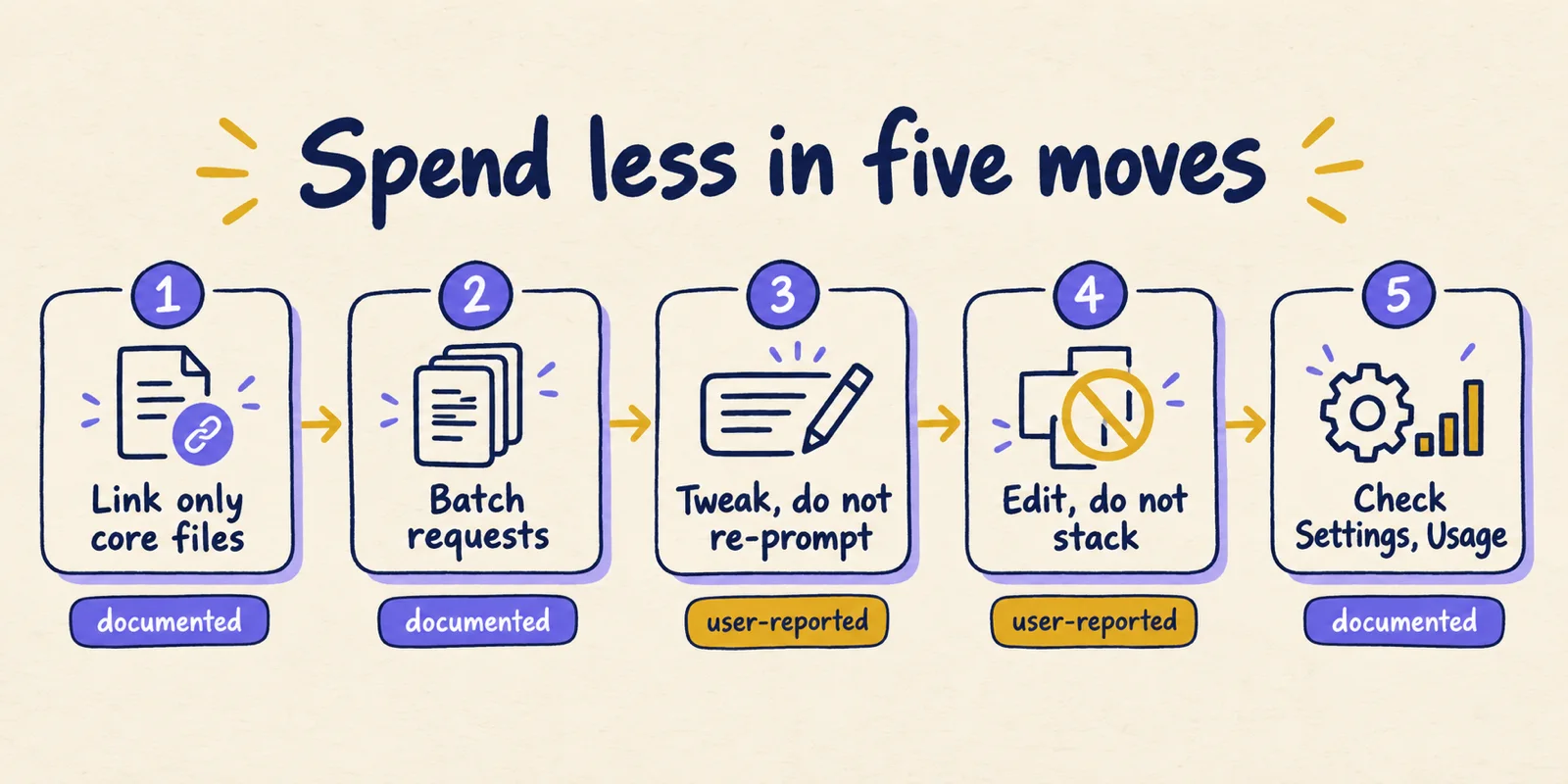
These moves come from Anthropic's general usage guidance and from the named practitioner tips above. Where a move rests on one person's report or on our reasoning, the label says so.
| Move | What to do | Evidence |
|---|---|---|
| Scope the onboarding | Link or upload the files that define the system (tokens, core components, one finished page) rather than a whole monorepo. | Documented direction: large codebases use more; Anthropic also advises real examples over specs. The advice to trim the repo is our inference. |
| Batch requests | Put related changes in one message instead of five. | Documented in general Claude usage guidance |
| Use Tweaks for small changes | Adjust colour, type and spacing with the panel's controls rather than re-prompting. | Reported by one practitioner before the pools merged; verify in your Usage view |
| Edit, do not stack | Edit an earlier message instead of appending a correction. | Reported by the same practitioner; not in Anthropic's docs |
| Watch the meter | Check Settings > Usage before and after a session to learn your own costs. | Documented |
The last move is the most reliable because it replaces everyone else's numbers with yours. Since Anthropic publishes no per-task cost, a before-and-after reading is the only measurement available to you.
A week-one protocol for a design-system onboarding
This protocol is our suggestion, built from the moves above. It is meant to keep the largest and least predictable cost, onboarding, from landing in the middle of a deadline.
- Open Settings > Usage and note the session and weekly readings before you start.
- Pick the smallest source set that defines your system: the token file, the core component folder, and one finished page. Leave out tests, build output and unrelated apps.
- Run onboarding at the start of a fresh session, not after a long chat, so the session limit is not already half spent.
- Check Usage again straight after onboarding and write the difference down. That is your own cost estimate for this system.
- Draft the first design from a single, specific message that names the layout, the audience and the sizes you need.
- Refine with the Tweaks controls and edited messages where they apply, checking Usage after each block of work.
- If you are near the limit, decide whether to wait for the reset or enable usage credits, which bill at standard API rates according to Anthropic's credits page.
Because Design shares the pool with Claude Code, do the same Usage check if you code in the same week. A design session can reduce what is left for coding, and the reverse.
Is Claude Design free, and what does it need?
Not on the free plan. Anthropic's pricing page lists Claude Design under Pro and higher plans, and the help page lists Pro, Max, Team and Enterprise. As of October 1, 2026 the pricing page shows Pro at $17 a month on an annual plan ($20 billed monthly), Max from $100, Team Standard at $20 per seat on annual billing, and Team Premium at $100. These prices can change.
Design is on by default for Pro, Max and Team. On Enterprise it is off until an owner turns it on in organization settings. The help page calls the product beta, so features and metering may change again.
When you hit the limit, the help page says Claude Design is unavailable until limits reset, unless you have enabled usage credits. Anthropic's credits page says usage after that point is billed at standard API pricing rates, and that credits are for Pro, Max 5x and Max 20x subscribers. Team and Enterprise billing differ, and the admin guide we read does not describe Design usage.
A watched budget beats a guessed one
The question behind the title has a plain answer. Claude Design costs whatever share of your plan's shared pool the work uses, Anthropic has not said how large that share is, and the way to learn it is to measure your own sessions.
What is solid today is short: one pool, beta status, directional guidance about codebases and iterations, and credits as the overflow valve. Everything with a percentage attached comes from individuals, usually from before the pools merged.
Spend less by shrinking what Claude has to read, asking for more in fewer messages, using the lighter controls for small edits, and checking Settings > Usage as you go. Check the help page again before a big project, because this is the part of the product that has already changed twice.