Creative tools & workflows
ElevenLabs Pricing: Budget for Finished Voiceovers
A decision-focused pricing guide for ElevenLabs: what the plan table actually promises, how credits convert to finished voiceover minutes under declared assumptions, and three workload budgets you can rerun for your own scripts.
· · Diagram Studio Editorial
ElevenLabs sells credits for generated audio, not finished minutes. The pricing page states the monthly allowance; what you actually pay for a finished voiceover depends on how many characters you generate, which model and surface you use, and how many takes you discard before accepting one.
This article builds a budgeting method around that reality and applies it to three workloads. Prices are a 4 November 2026 snapshot of ElevenLabs’ USD rates and exclude taxes; all workload figures are modeled estimates under declared assumptions, not results from product testing.
Direct answer
ElevenLabs sells generation credits, not finished minutes. Free output has no commercial license; paid plans add one at generation time except Beta Services. Multilingual v2 uses 1 credit per character, so estimate finished minutes times about 950 characters per minute times a retry multiplier for discarded takes. Starter ($6, 30,000 credits) fits light solo work; Creator ($22, 121,000) fits 60 narrated minutes monthly at 60% acceptance; Pro ($99, 600,000) can cover a modeled six-hour audiobook month. Computed annual billing cuts the monthly rate about 16.7%; PAYG covers spikes.
Licensing comes before volume
Your first plan decision is a license decision, not a credit decision. According to ElevenLabs’ commercial-use help, generating while signed out or on the free tier gives you no commercial license. Published noncommercial output must carry the attribution the platform specifies. Any monetized use, such as an ad-supported channel, client voiceover work, or a paid course, therefore starts at a paid plan even if you only produce a few minutes a month.
The practical cases:
- Free or signed-out: noncommercial publication with attribution; no commercial license.
- Paid plan: commercial license included, subject to the platform terms, applicable law, prohibited-use policy, and service-specific conditions.
- Beta Services: no commercial or production use under the Beta Services Addendum.
The beta point trips teams that treat a released preview feature as safe for client work. Under the cited terms, a beta feature is not a production tool. This is a summary of vendor conditions, not legal advice; the governing terms control.
Rights attach at generation time. Eligible audio created while a paid subscription is active can continue to be used commercially after the subscription ends, subject to the governing conditions. Earlier free-tier renders do not gain a commercial license when you upgrade later. Before generating, ask whether the output will be used for monetized or client work; if yes, generate it on a paid plan from the first take.
What the plan table actually promises
ElevenLabs publishes current monthly recurring prices and credit allowances in US dollars. The table below comes from the pricing page, dated 4 November 2026, and excludes taxes. The seat columns come from the workspace members documentation.
| Plan | Monthly price | Monthly credits | Full Seats included | Basic Seats included |
|---|---|---|---|---|
| Free | $0 | 10,000 | 1 | 20 |
| Starter | $6 | 30,000 | 1 | 20 |
| Creator | $22 | 121,000 | 1 | 20 |
| Pro | $99 | 600,000 | 1 | 20 |
| Scale | $299 | 1,800,000 | 3 | 20 |
| Business | $990 | 6,000,000 | 10 | 20 |
Enterprise is quoted individually. Checkout adds taxes, and other currency rates will differ. The table states allowances, not finished audio.
Credits are spent on generation, not downloads. The billing documentation is explicit: subscription quotas reset monthly, including on annual subscriptions, and credits are shared across products. Generated-minute estimates depend on the product and model, so the table cannot be divided evenly into deliverable minutes.
A concrete example keeps the difference visible. Multilingual v2 runs at a listed rate of 1 credit per character. A single pass over a 20,000-character script consumes 20,000 credits. That fits inside Starter, but it spends two-thirds of the month on one attempt before retries or other usage.
The pricing page also shows first-month offers and an expired promotion banner. Neither offer was confirmed as currently valid at checkout, so the calculations below leave them out.
Model choice decides the per-character rate
The model determines how many credits a script burns. The official model reference currently lists Eleven v4, v4 Turbo, v3, v3 Conversational, Multilingual v2, and Flash v2.5, with differences in language support, latency, expressive controls, endpoint compatibility, and cost. These are listed capabilities, not measured quality rankings; no listening test informs this article.
For pricing, Multilingual v2 has the clearest published rate: 1 credit per character. The pricing FAQ also documents a Flash/Turbo API range of 0.5–1 credit per character depending on model and plan. There is no single universal rate for all models and endpoints. You must name the model and surface before you can estimate.
The Creative UI and API draw from the same credit pool. Subscription credits are consumed before PAYG. The Pay As You Go documentation distinguishes lower API rates from UI rates but publishes no one-size discount. The same script can produce different charges on different surfaces; verify the rate for your specific model and endpoint.
Budgeting for discarded takes
The text-to-speech workflow described by ElevenLabs is generate, preview, revise. Conditional free regeneration exists, but it is not a guarantee that every edit or rerun is free. Plan as though retries consume credits, and treat any free generation as a bonus.
The planning formula:
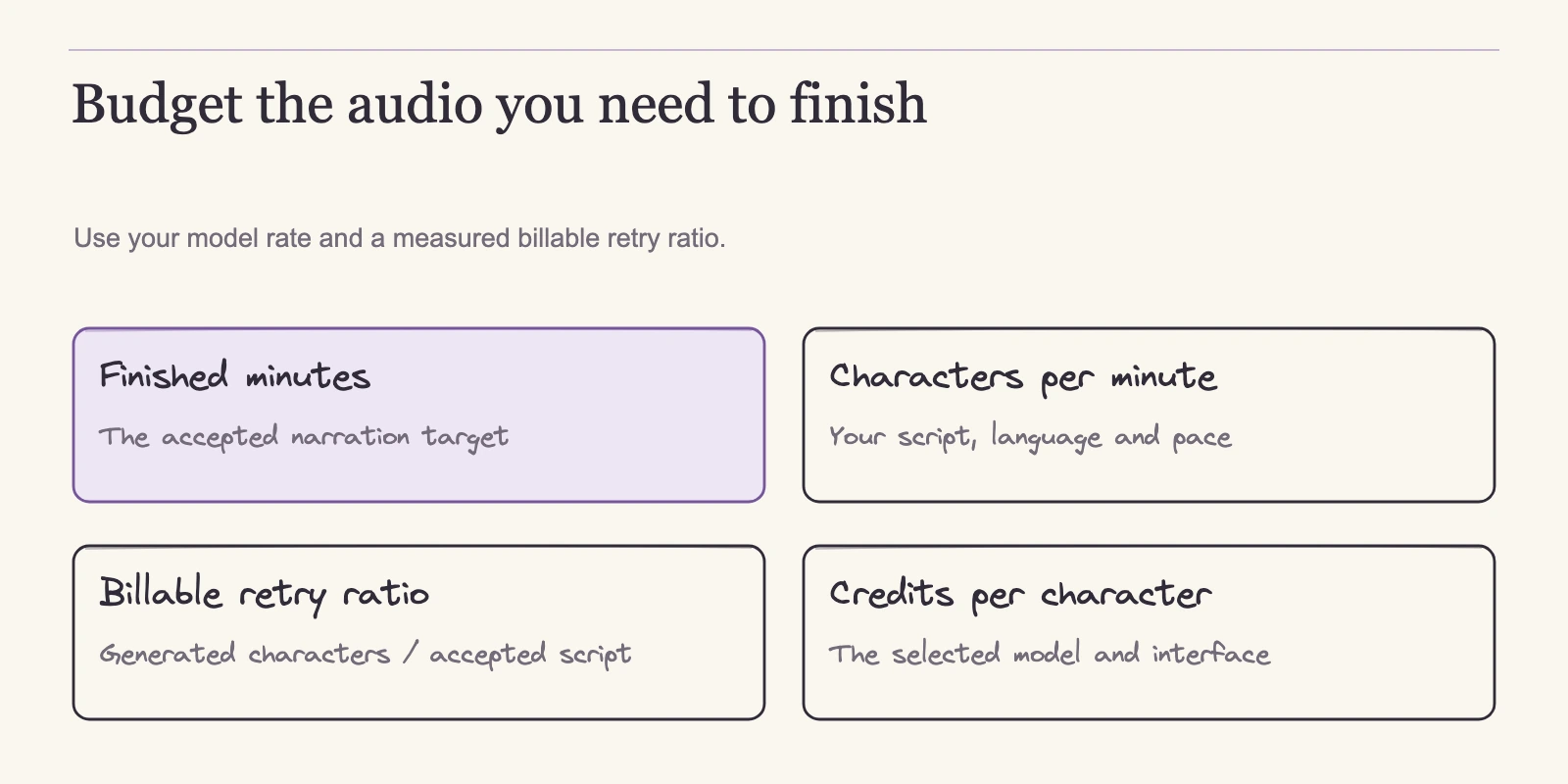
estimated credits = finished minutes × characters per minute × retry multiplier × credits per character
The retry multiplier is total billable generated characters divided by accepted-script characters. If retries rerun the full script, this equals attempts divided by accepted takes. A short patch retake charges fewer characters than a whole-script rerun, so a count-based acceptance rate alone is not enough.
About 950 characters per minute is a reasonable editorial default for English narration, roughly 150 words at 6.3 characters per word. It is an assumption, not an official metric; replace it with your own script measurements if you have them.
A ten-minute deliverable at 950 characters per minute needs about 9,500 accepted characters. The sensitivity appears quickly:
| Acceptance rate | Retry multiplier | Generated characters | Multilingual v2 credits |
|---|---|---|---|
| 100% | 1.00 | 9,500 | 9,500 |
| 75% | 4/3 ≈ 1.33 | ~12,667 | ~12,700 |
| 50% | 2.00 | 19,000 | 19,000 |
One ten-minute piece swings from about 9,500 to 19,000 credits depending only on how often you keep the first take. In plan terms, Starter’s 30,000 credits cover about 31 fully accepted minutes of Multilingual v2 audio at 950 characters per minute with zero retries. Two ten-minute deliverables at 75% acceptance would use about 25,300 credits; the same two at 50% acceptance would exceed the allowance. Optimism about acceptance makes any plan look cheaper than it is. Budget with a conservative multiplier and treat unused headroom as margin, not waste.
Rollover, PAYG, and the limits of credit buffers
The demand estimate tells you what your workload needs; buffer rules tell you how much of that need a plan absorbs before you pay extra. ElevenLabs runs two separate systems, and confusing them is the fastest way to overestimate how long a balance lasts.
- Paid subscription rollover permits up to two prior monthly allocations when eligibility is maintained, capping the balance near three times the monthly allowance. Quotas still reset monthly, including on annual subscriptions. The buffer suits workloads with light and heavy months, but it cannot finance a year of saving.
- PAYG is prepaid funding for self-serve tiers, including Free. Subscription credits are consumed first. PAYG has no monthly rollover cap, but it expires 12 months after purchase, so no monthly cap does not mean no expiry. The minimum top-up is $5 USD or INR500, top-ups are nonrefundable, and Auto Top Up can fail or be delayed.
- Balances retain dollar value across plan changes while displayed credits convert at the plan’s rate. Feature and voice limits stay tied to the underlying subscription, so PAYG adds spending room, not a higher tier.
- Enterprise remains overage-based, and eligible existing accounts on legacy usage-based billing follow different rules. Confirm which mode applies to your account.
Cancellation or downgrade effects depend on the billing cycle and can remove unused subscription credits. Stored credits are a working buffer, not a savings account.
| System | Cap | Expiry | Role |
|---|---|---|---|
| Subscription rollover | Up to two prior monthly allocations, roughly three times the monthly allowance | Monthly resets continue; credits can be removed on cancellation or downgrade | Smooths light and heavy months |
| PAYG | No monthly rollover cap | 12 months from purchase | Covers spikes and one-off projects |
| Legacy usage-based / Enterprise overage | Differs from PAYG | Depends on account and billing mode | Existing usage-based accounts; Enterprise |
Annual billing, seats, and when team size changes the picture
The pricing FAQ describes annual billing as 10 months paid for 12 months of service. Computed from the monthly recurring rates, the totals are Starter $60, Creator $220, Pro $990, Scale $2,990, and Business $9,900, with monthly equivalents of $5, $18.33, $82.50, $249.17, and $825. These are arithmetic conversions from the 4 November 2026 USD snapshot, not checkout quotes; taxes and regional currency can change the final invoice.
| Plan | Monthly price (USD) | Monthly credits | Annual total (computed) | Monthly equivalent (computed) | Per-credit at monthly price (computed) |
|---|---|---|---|---|---|
| Starter | $6 | 30,000 | $60 | $5 | ~$0.00020 |
| Creator | $22 | 121,000 | $220 | $18.33 | ~$0.00018 |
| Pro | $99 | 600,000 | $990 | $82.50 | ~$0.000165 |
| Scale | $299 | 1,800,000 | $2,990 | $249.17 | ~$0.000166 |
| Business | $990 | 6,000,000 | $9,900 | $825 | ~$0.000165 |
Free, at $0 and 10,000 credits, has no paid price to convert and is excluded from the table. Per-credit figures divide the monthly recurring price by the monthly credit allowance. Using the annual monthly equivalent lowers every per-credit figure by about 16.7% without changing the ordering across plans.
Annual billing does not raise the monthly credit allowance or change the monthly reset. Its only effect is price: about 16.7% less per month than paying monthly, if the plan stays active the full year. The tradeoff is commitment, so confirm the cancellation policy before paying annually.
From Creator upward, the computed price per credit sits in a narrow band between roughly $0.000165 and $0.00018. Larger plans buy more capacity and more seats, not dramatically cheaper credits. Choose the tier whose capacity fits; consider annual billing separately if you want the discount.
The workspace members documentation distinguishes two seat types. Full Seats are used for normal creative work, and admins hold them. Basic Seats primarily serve ElevenAgents and the ElevenAPI with limited ElevenCreative access. Every listed plan includes 20 Basic Seats plus the Full Seats shown in the plan table. If your team’s contributors need unrestricted Full access, count Full Seats.
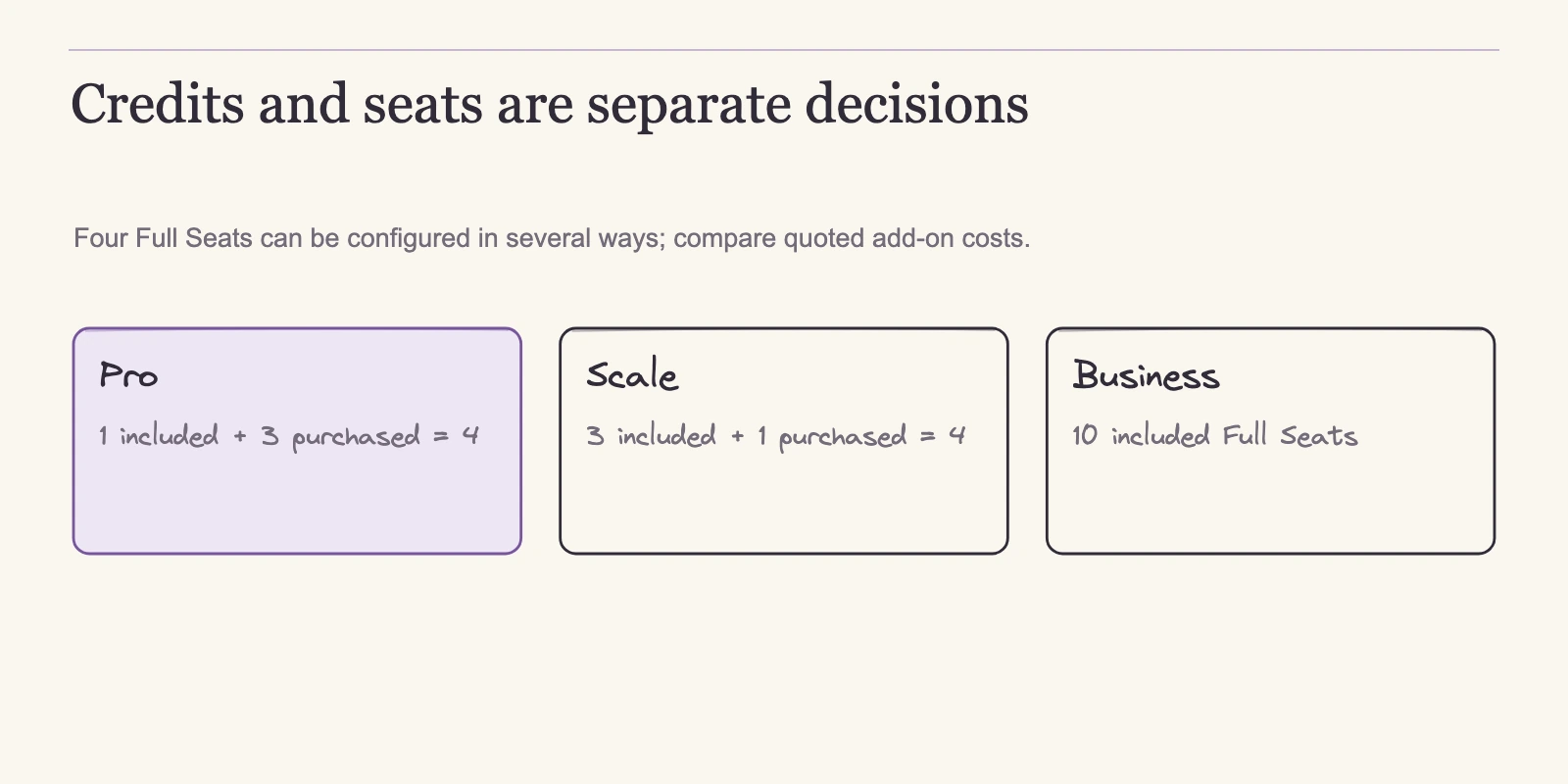
Pro, Scale, and Business admins can purchase additional Full Seats, up to 11 total including included seats. Each purchase also adds shared-pool credits. The current seat price and added-credit amount are shown in Workspace Settings and are not quoted here. A four-person full-access team can be configured as Pro with three purchased seats, Scale with one purchased seat, or Business with ten included. Compare the quoted add-on cost against the higher plan price before assuming a jump is necessary. Do not assume every participant requires a Full Seat; some limited or API-only roles can fit Basic access. Verify the actual roles and consumption limits before buying seats.
Three workload budgets
Each example below fixes a monthly finished-minute target, sets an acceptance rate, converts finished minutes to accepted characters, applies the retry multiplier, and compares the estimate against the published monthly allowances. All three assume Multilingual v2 at its listed rate of 1 credit per character and 950 characters per minute. The acceptance rates are declared assumptions for illustration, not measured results.
Workload 1: a 20-minute YouTube narration
A solo creator produces 20 finished minutes of narration per month. At 75% acceptance, the retry multiplier is 4/3. The accepted script runs about 19,000 characters, so the estimated draw is about 25,300 credits. That fits Starter’s 30,000 credit allowance with about 4,700 credits of headroom, giving a per-minute cost of about $0.30 on a dedicated Starter plan.
At 50% acceptance, the multiplier is 2.0, the estimate climbs to about 38,000 credits, and the plan fit moves to Creator. A revision-heavy process therefore argues for Creator from the start; the cushion raises the per-minute cost to about $1.10.
Workload 2: a 60-minute audiobook chapter block
An author narrates 60 finished minutes per month. At 60% acceptance, the multiplier is 5/3. The accepted script is about 57,000 characters, producing an estimated draw of about 95,000 credits. Creator’s 121,000 allowance clears that with about 26,000 credits to spare, and the per-minute cost on a dedicated Creator plan is about $0.37.
Chapter blocks understate full-book demand. If a six-hour audiobook must be produced within one month, the peak draw is about 570,000 credits, so the plan check moves to Pro. If the same book runs over several months at 60 finished minutes per month, each month’s draw stays near 95,000 credits and Creator continues to fit. Check the peak month, not the project total.
Workload 3: a 30-minute client training batch
A solo narrator delivers 30 finished minutes of client training per month. At 70% acceptance, the multiplier is 10/7. The accepted script is about 28,500 characters, yielding an estimated draw of about 40,700 credits. Creator fits with about 80,300 credits of headroom, and the per-minute cost on a dedicated Creator plan is about $0.73.
This row is a credit fit for a sole producer. If multiple team members need Full Seats, seats govern first, and the effective price depends on the quoted add-on seat cost or the higher plan price.
| Workload | Finished min/month | Acceptance | Retry multiplier | Est. credits | Smallest fitting plan | Headroom | Cost per finished min |
|---|---|---|---|---|---|---|---|
| YouTube narration | 20 | 75% | 4/3 | ~25,300 | Starter | ~4,700 | ~$0.30 |
| Audiobook chapter block | 60 | 60% | 5/3 | ~95,000 | Creator | ~26,000 | ~$0.37 |
| Client training batch | 30 | 70% | 10/7 | ~40,700 | Creator | ~80,300 | ~$0.73 |
Per-minute costs divide the plan’s monthly sticker price by the finished-minute target and assume the plan is dedicated to that workload. Sharing a plan or adding PAYG changes the allocation.
Run the same arithmetic for your own workload, then pick the smallest plan whose plausible peak-month estimate fits the allowance after the licensing and seat gates. Use PAYG for spikes beyond the plan’s ceiling, keeping its 12-month expiry and $5 minimum top-up in mind. If you are still comparing providers, focus that comparison on voice quality and suitability; this article covers ElevenLabs pricing mechanics only. Before paying, confirm the credit rate for the model you intend to use and the checkout total, including taxes and any promotion eligibility.
Frequently asked questions
Can I use free-tier ElevenLabs voiceovers on a monetized YouTube channel?
Free or signed-out generation carries no commercial license, and published noncommercial output requires specified attribution. A monetized channel counts as commercial use, so free output falls outside its license. Paid plans include a commercial license except for Beta Services. Check the current terms because service-specific conditions apply.
Do regenerations, previews, and edits consume credits?
Credits are consumed on generation, not downloads. The billing documentation mentions conditional free regeneration but does not guarantee every rerun or edit is free. Acceptance is rarely 100%, so a safer budget treats iteration as a cost and includes a retry multiplier above 1.
Do unused subscription credits roll over, and for how long?
Paid subscription rollover permits up to two prior monthly allocations while eligibility is maintained, capping the balance near three times the monthly allowance. Quotas reset monthly, including on annual subscriptions. PAYG balances, by contrast, last 12 months from purchase and have no monthly rollover cap.
Is annual billing actually cheaper?
The pricing FAQ describes annual billing as 10 months paid for 12 months of service. From the 4 November 2026 USD rates, computed annual totals range from $60 on Starter to $9,900 on Business, roughly 16.7% below the monthly recurring price. Annual billing does not raise the monthly credit allowance; it is a cash-flow and commitment decision.
Does generating through the API cost less than using the app interface?
The Pay As You Go documentation distinguishes lower API rates from UI rates, but the inspected sources publish no single discount figure. Credit consumption also varies by model: Multilingual v2 uses 1 credit per character, and Flash/Turbo API rates are published in a 0.5–1 credit-per-character range. Check the rate for your specific model and endpoint before comparing.
What happens to commercial rights if I cancel or downgrade?
Eligible content generated while on a paid plan can continue to be used commercially after the subscription ends, subject to governing conditions. Output generated on the free tier does not gain a commercial license by upgrading later. Beta Services output cannot be used commercially or in production.
Turn the method into your worksheet
The pricing table is a starting point, not a quote. To get a usable budget, keep the calculation in one unit chain: finished minutes become accepted script characters, accepted characters become generated characters after retries, and the model’s credit rate converts that into credits. Three gates matter at every decision: licensing before volume, model before rate, and seats before plan.
The most common failure is treating an allowance as a guarantee of finished audio. The examples above show how quickly a lower acceptance rate or a larger project changes the plan fit. Build a small worksheet with your own numbers, date it, and revisit it when prices, model surfaces, or your workflow change. That keeps the budget current instead of treating a snapshot as a permanent number.